Why Franklin, NH Homeowners Are Receiving “Unregulated Contaminant” Notices – and How a Reverse Osmosis System Can Protect Your Water
Understanding the Recent Notice from Franklin Water Works
If you live in Franklin, NH, you may have recently received an official letter from Franklin Water Works titled “Important Information About Your Drinking Water: Availability of Monitoring Data for Unregulated Contaminants.” The notice explains that the city’s water system has tested for substances that don’t yet have federal drinking water standards under the Environmental Protection Agency (EPA).
While the notice assures residents that no immediate action is required, it’s natural to wonder — what exactly is in my water?
At LaChance Water Filtration, we specialize in helping Lakes Region homeowners understand these kinds of alerts. We’ve served communities across Franklin, Tilton, Northfield, Sanbornton, and Bristol for years, and this type of notice is becoming more common as new contaminants are discovered in drinking water supplies.
What “Unregulated Contaminants” Really Means
When you read “unregulated contaminant,” it doesn’t mean the water is unsafe — but it also doesn’t mean it’s clean. It simply means that the EPA hasn’t yet set a legal limit for that substance in public drinking water. These compounds are being studied to determine whether they could pose a risk to human health.
Examples of unregulated contaminants include:
- PFAS (per- and polyfluoroalkyl substances) are often referred to as “forever chemicals.”
- Manganese, strontium, and chromium-6
- Pharmaceutical residues and personal-care product traces
- Disinfection byproducts that form when chlorine reacts with organic matter
Municipal water systems like Franklin Water Works are required to monitor for these substances to help regulators decide whether to create new safety standards.
But here’s the key point: testing and monitoring don’t remove contaminants — they only record them.
Monitoring Isn’t the Same as Removing
The EPA’s testing program, known as the Unregulated Contaminant Monitoring Rule (UCMR), helps gather nationwide data. Still, it doesn’t guarantee that the water reaching your faucet is free from these substances.
Even if the results fall “below the minimum reporting level,” trace amounts of contaminants may still be present. Over time, exposure to low concentrations can accumulate, particularly with chemicals like PFAS, which are known to persist in both the environment and the human body.
This is why many Lakes Region homeowners — especially those in Franklin and surrounding communities — are taking proactive steps to safeguard their drinking water with a reverse osmosis (RO) system.
Common Unregulated Contaminants Found in New Hampshire Water
Across New Hampshire, including the Merrimack River watershed that supplies Franklin Water Works, testing has identified several recurring substances:
- PFAS, commonly referred to as “forever chemicals,” are a group of synthetic compounds known for their persistence in the environment and the human body. These substances have been associated with a range of health concerns, including weakened immune function, reproductive challenges, and thyroid dysfunction, raising significant alarm among health experts and regulators alike.
- Manganese is a naturally occurring element that plays a vital role in various biological processes. However, when present in excessive amounts, it can pose risks to neurological health, potentially leading to cognitive impairments and other neurological disorders. Additionally, high concentrations of manganese can cause unsightly surface staining, which can be particularly problematic in both residential and industrial settings.
- Chromium-6 is a hazardous industrial metal contaminant that can be detected in specific water systems. This toxic substance, a form of chromium, often originates in industrial processes and can pose significant health risks to individuals exposed through drinking water or other sources.
- Disinfection Byproducts (DBPs) are substances that form when chlorine reacts with organic matter in water. These byproducts can result from chemical reactions during the disinfection process, in which chlorine is used to eliminate harmful pathogens. As chlorine breaks down organic matter, it forms various compounds that can affect water quality and safety. Understanding DBPs is essential for managing water treatment processes effectively and ensuring public health.
- Sodium and chloride levels have been elevated in the areas of Franklin and Tilton, primarily due to runoff from road salt. This runoff frequently occurs during and after winter storms when salt is spread on roads to prevent ice formation, leading to increased concentrations of these substances in nearby water sources.
Each of these may appear in tiny amounts, but when it comes to your family’s health, even trace levels can be concerning.
How Reverse Osmosis Works to Remove Contaminants
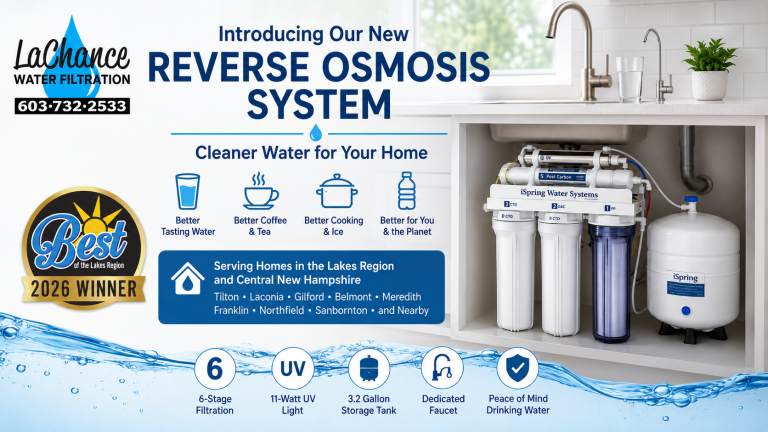
Reverse osmosis (RO) is one of the most effective water purification methods available. It uses a semi-permeable membrane to filter out contaminants at the molecular level — including many that standard municipal systems can’t remove.
Here’s how it works:
- Pre-filtration: Removes larger sediment, rust, and chlorine.
- RO Membrane: Pressurized water passes through a membrane that blocks particles, heavy metals, and chemicals down to 0.0001 microns.
- Post-filtration and polishing: Final filters enhance taste and purity before water reaches your faucet.
The result is bottle-quality water — clean, clear, and safe for drinking, cooking, and even your pets.
At LaChance Water Filtration, our whole-home reverse osmosis systems are designed to treat every tap, not just one sink. This means protection from harmful contaminants throughout your home — including your showers, ice makers, and washing machines.
Why Franklin and Lakes Region Homeowners Are Paying Attention
Franklin sits at a crossroads of several key New Hampshire watersheds. Runoff from nearby communities, roadways, and industrial zones can all contribute to water contamination. Even when the city’s treatment plant meets EPA standards, new contaminants are constantly being added to the list for review.
Franklin’s recent letter isn’t cause for panic — but it’s a clear reminder to take control of your home’s water quality.
Many residents in Franklin, Tilton, Northfield, Bristol, and Sanbornton have already installed RO systems from LaChance Water Filtration to eliminate uncertainty and enjoy consistent, high-quality water every day.
The Benefits of Installing a Reverse Osmosis System
An RO system provides more than just peace of mind. Homeowners who install one notice immediate and long-term benefits:
- Healthier drinking water: Removes up to 99% of dissolved solids, lead, PFAS, and other contaminants.
- Better-tasting food and beverages: Coffee, tea, soups, and ice taste fresher.
- Appliance protection: Reduces scale and buildup in dishwashers, water heaters, and washing machines.
- Softer skin and hair: Clean, filtered water reduces irritation from chlorine and metals.
- Eco-friendly alternative: No need to rely on bottled water — save money and plastic waste.
For Franklin homeowners, this is one of the simplest and most effective home improvements you can make.
Why Choose LaChance Water Filtration
LaChance Water Filtration has been serving the Lakes Region and Central New Hampshire for over 30 years. Our family-run team understands local water challenges better than anyone — from arsenic and radon in private wells to chlorine and PFAS in municipal systems.
We were honored to be voted Best Water Filtration Company in the Lakes Region for 2025 — and that’s because our customers trust us to do more than install a system. We help them understand what’s in their water and how to fix it for good.
Our process includes:
- Water testing and analysis
- Customized system design based on your home and water source
- Professional installation by certified technicians
- Ongoing maintenance and support to keep your system running efficiently
Every home’s water is different — but every homeowner deserves clean, safe drinking water.
The Long-Term Cost of Doing Nothing
Some homeowners assume their municipal water is “good enough,” especially after receiving a letter that says “no corrective steps are needed.” But water quality is about more than meeting today’s minimum standards.
The EPA is still studying the health effects of unregulated contaminants. As research evolves, today’s “safe” levels could become tomorrow’s violations. By investing in a reverse osmosis system now, you protect your family before regulations catch up.
Plus, when you consider the ongoing cost of bottled water, appliance wear, and potential plumbing damage from mineral buildup, an RO system quickly pays for itself.
Taking Control of Your Water Quality
If you received the Franklin Water Works notice, here’s what you can do today:
- Read the notice carefully. Understand that it’s informational, not a guarantee of purity.
- Schedule a professional water test with LaChance Water Filtration. We’ll analyze your home’s specific water chemistry — whether you’re on public water or a private well.
- Get a personalized solution. We’ll recommend the correct filtration or reverse osmosis system for your needs and budget.
- Enjoy clean, clear water. Once installed, you’ll have complete confidence every time you turn on the tap.
Trusted by Franklin and Lakes Region Families
LaChance Water Filtration systems are installed in homes across the Lakes Region — from Franklin to Laconia, Gilford, Meredith, and beyond. Each system is built to handle New Hampshire’s unique water conditions, ensuring long-term reliability and low maintenance.
When it comes to protecting your family’s health and your home’s plumbing, nothing beats the performance and dependability of a LaChance reverse osmosis system.
Ready to Learn What’s in Your Water?
If you received the recent Franklin Water Works notice or have any concerns about your water quality, now is the perfect time to act.
We’ll help you interpret your water report, recommend the right system, and ensure your home’s water is cleaner, safer, and better than bottled water.
LaChance Water Filtration – Voted Best in the Lakes Region 2025
Proudly serving Franklin, Tilton, Northfield, Sanbornton, Bristol, Laconia, and surrounding New Hampshire communities.
💧 Better than bottled. Safer than standard. LaChance Water Filtration keeps New Hampshire families healthy and hydrated year-round.